
the wire · #topnews · 2026-07-28
NASA's X-59 "frankenjet" tests supersonic flight without the sonic boom
Cech This Review
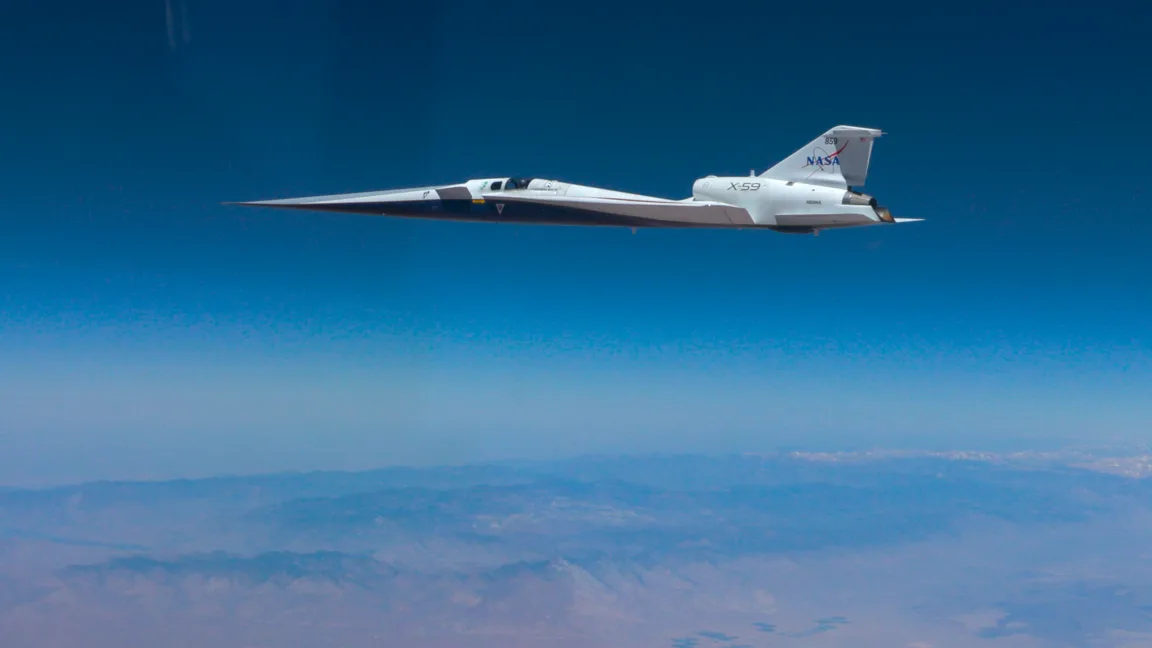
NASA is quietly rewriting the rules of aviation history with its X-59 Quesst aircraft. For over twenty years the sky has been silent of supersonic passenger jets since the Concorde retired. Now this experimental plane aims to change that narrative by turning deafening sonic booms into gentle thumps. According to Ars Technica the sound is comparable to a car door slamming shut from twenty feet away. This subtle acoustic shift is not just a novelty. It is the key to unlocking overland supersonic travel which has been banned for decades due to noise complaints.
The X-59 is far from a rough prototype cobbled together from spare parts. Jim Less a NASA test pilot described these experimental planes as usually being bare bones. The X-59 however is built for robustness and mobility. It is designed to fly across the United States rather than staying confined to restricted airspace near Edwards Air Force Base. This mobility is critical because NASA needs to gather data from diverse environments and populations. The goal is to prove that the technology is reliable enough for real world deployment.
What makes this mission unique is the human element involved in the testing phase. NASA plans to take the X-59 on a tour of various cities and towns. Residents will hear the quiet thumps and provide direct feedback on the noise. This crowdsourced data collection is a brilliant move for an agency that has struggled with public perception of supersonic flight. It shifts the conversation from theoretical physics to lived experience. People can judge the noise based on their own comfort levels rather than abstract decibel charts.
This approach has profound implications for the future of commercial aviation. If the flight test program succeeds it could influence the design of future supersonic airliners. These new jets could potentially fly overland routes without rattling buildings or nerves. The current ban on overland supersonic flight is largely based on the assumption that sonic booms are inherently disruptive. The X-59 challenges that assumption with empirical evidence. Airlines could soon offer faster transcontinental flights without the regulatory hurdles of noise complaints.
From an AI perspective this data collection process is a goldmine for machine learning models. The feedback from residents across different geographic locations can train algorithms to predict noise impact in urban planning. We could see AI systems integrated into flight path optimization to minimize community disturbance. This creates a feedback loop where technology improves public acceptance which in turn allows for more efficient routing. The intersection of aerospace engineering and data science is where the real innovation lies here.
The broader tech industry should watch this closely as it mirrors trends in autonomous vehicle testing. Just as self-driving cars need public trust to scale the aviation industry needs acoustic trust. The X-59 tour is essentially a public relations and data gathering exercise disguised as a flight test. It demonstrates that regulatory barriers can be dismantled through transparency and community engagement. This model could be applied to other controversial technologies like drone delivery or hyperloop systems.
What this means for you is that the definition of speed and convenience in travel is about to expand. If you work in logistics or travel planning start thinking about how supersonic routes might change global connectivity. You can try this prompt with an AI assistant to explore the economic impact: Analyze the potential economic benefits of reducing transatlantic flight time by fifty percent using supersonic technology. Include factors like time zone management and cargo logistics to provide a comprehensive business case for early adopters.
Reporting basis: original story
← back to The Wire